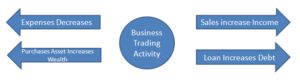
Part 2 of our Dummies guide to Debit & credit
Of course finance developed and we no longer barter with vegetables. Our worth is symbolised in units of currency which for convenience sake is stored in a bank. Income is deposited into our account and withdrawals represent money spent. Yet not all transitions are just for “ins and outs”. Just because money is going out of the bank account does not necessarily make it an expense. Some transactions can be for items that you would own or pay down amounts owed. When buying a house you purchase an asset. Payments made on the mortgage reduce the amount that is owed to the bank. If you are renting, it would be an expense as you do not own the property and the payment goes directly to the landlord for hire of premises for a specified period of time. The transaction may relate to accommodation, but its purpose determines whether it is a cost or affects the value of what you possess.
For individuals, a salary is considered an income and payments for food, travel, electricity, telephone are an expense. Amounts paid to an investment or pension would count towards an asset, (even if realised in the future) and loan repayments would reduce a debt. All these transactions take money out of the bank account but some are for general living while others affect our overall worth.
This principle is the same for a business. Items such as office rent, wages, telephone, stationery, etc. are usually related to bringing goods or services to market, therefore a cost. Purchases relating to acquiring buildings, equipment, furniture, patents, these reflect upon the value of the enterprise.
A good example is purchasing stock as once bought it is considered to be an asset. (If a company goes bankrupt a liquidator would see the unsold stock as an acquisition that can be sold on to relieve any outstanding liabilities). As soon as the item is sold to a customer then it is an expense of trade, the item is delivered out of the warehouse to the ownership of the customer, and the worth of the business is reduced by the purchase price for that item. In exchange, the assets of the business increases by the value of the sale, (whether an invoice owed or cash in the bank). This should be to the business’s advantage as the margin set at the sales price should be greater than the cost, producing a profit, which in turn increases the value of the business.
For a practical exercise download our “Example of journal by stockmovement” from our downloads section.
If sales income raise the level of worth of a business and expenses decrease that amount, then acquiring assets or drawing down debt are best understood as transactions that go across as they don’t reflect the business’s trading activity. See diagram below;
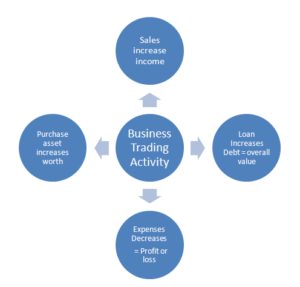 If you follow the lines up and down these types of transactions relate to core business activity which affects your profit and loss. Following the lines across, anything to do with buying assets or clearing down debt, that reflects the overall value of the business, or balance sheet.
So if an investor puts money into the business it may increase the bank account but if it was recorded as a sale it would make the business appear to be doing better than it really is. If a loan repayment is put as an expense, the business would look less profitable. Transactions that are not properly recorded can misrepresent the current financial position.
To get a true picture of how a business is performing you would need to look at it from two different perspectives. One is gaining income over expenses in providing goods and services to market. The other is its current value, which is what it owns as opposed to its liabilities. It is preferable if both statements produce a positive result so it has more income than expenses and it owns more than it owes.