Part 3 of our Dummies guide to Debit & credit
Welcome to the final part of our 3 part series, this part will focus on types of transactions and how to classify them.
As we have seen each transaction has become a lot more complicated than exchanging carrots and turnips. An amount can be recorded as a sale or an asset purchase. A payment could be an expense or clearing down a debt. It would be easy to get things the wrong way round and distort the true position of the company. To help keep track, a system was developed to help people record these transactions in “the right place”.
When Peasant A recorded the first “30 day invoice” it was the same amount of carrots for the sale as the amount owed. To write that down it became easy to draw a line down the middle of the page and write the amount owed on the left hand side and the value of the sale on the right. Someone coined a phrase “debit” for the left hand side and “credit” for the right, and it stuck ever since.
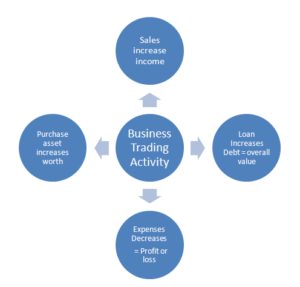
If we take our previous diagram and lay the “up and down” arrow on its side, then that is basically tells us which way they go.
 This system is best remembered by an anagram:
| Debit | Clic |
| Debtor | Credit |
| Expense | Liability |
| Asset | Income |
| Debit | Capital |
Each transaction of a double entry will affect one side and then the other.
The following exercise will hopefully make this clear.
Month 1:
| Debit | Clic | ||
| Debtor | Credit | ||
| Expense | Liability | ||
| Asset | 100 | Income | |
| Debit | Capital | 100 |
If a business owner wants to start a business he would stump up some cash to buy equipment or supplies so he can start trading as he needs to do this before getting a sale. So this one transaction has the two sides the one hundred pound is put in the bank account (Asset) and the business owner keeps track of how much he has put in (Capital).
Notice there is nothing on the profit and loss accounts (Income/expense) as no trade has taken place.
Month 2:
With his £100 he has in the bank he buys £50 worth of materials for resale. Instead of paying cash straight away he starts an account with his local supplier and promises to pay them in 30 days.
| Debit | Clic | ||
| Debtor | Credit | 50 | |
| Expense | 50 | Liability | |
| Asset | 100 | Income | |
| Debit | Capital | 100 |
The debit side recognises the expense, the credit side what he owes his supplier. The credit side effects the balance sheet but the debit goes to the P&L as an expense.
Month 3:
The next he sells his materials, at a mark-up, for £100.00 and his customer says he will pay him in 30 days. The transaction is as follows.
| Debit | Clic | ||
| Debtor | 100 | Credit | 50 |
| Expense | 50 | Liability | |
| Asset | 100 | Income | 100 |
| Debit | Capital | 100 |
It’s a mirror of the purchase transaction with the debtors showing how much is owed to him and the credit side the value of the sale. So there is £100 of income against £50 expenses leaving £50 profit. The balance sheet says he owns £100 in the bank account and is owed £100 from a customer but has £50 yet to pay out, so the current worth of the company is £150. Notice that this “balances” with his capital input of £100 and his remaining profit of £50. (Ah hah, no prizes for why it’s called a balance sheet)
Month 4:
Next month his customer pays the £100 early.
| Debit | Clic | ||
| Debtor | Credit | 50 | |
| Expense | 50 | Liability | |
| Asset | 200 | Income | 100 |
| Debit | Capital | 100 |
The amount owing is released and the bank account increases. From a balance sheet point of view the value does not change, it just transfers from debtors into cash. As soon as a sales invoice is raised it is considered a legal contract and is recognised as your income regardless of whether it has been paid to you or not.
Now he clears down what he owes his supplier.
| Debit | Clic | ||
| Debtor | Credit | ||
| Expense | 50 | Liability | |
| Asset | 150 | Income | 100 |
| Debit | Capital | 100 |
£50 is paid out of the bank account reducing the amount held, but clears down the debt as there is now nothing owing. None of this affects the profit and loss and the balance sheet does not change in value but it does change what is owned and owed as the company has fewer assets but now no liabilities.
At the end of the financial year the income and expenses are matched off and the remaining profit added (or reduced with a loss) against the capital to show how much the owner has increased his investment. The profit and loss accounts are brought to zero to begin again for the next financial year. Once this is cleared off it is only the balance sheet items that remain. In this case his £50 profit (income against expenses) is added to his capital of £100 as represented by £150 in the bank. Now that particular period is closed trading transactions are inputted for the next financial year.
| Debit | Clic | ||
| Debtor | Credit | ||
| Expense | Liability | ||
| Asset | 150 | Income | |
| Debit | Capital | 150 |
See our stock movement exercise in the downloads section.